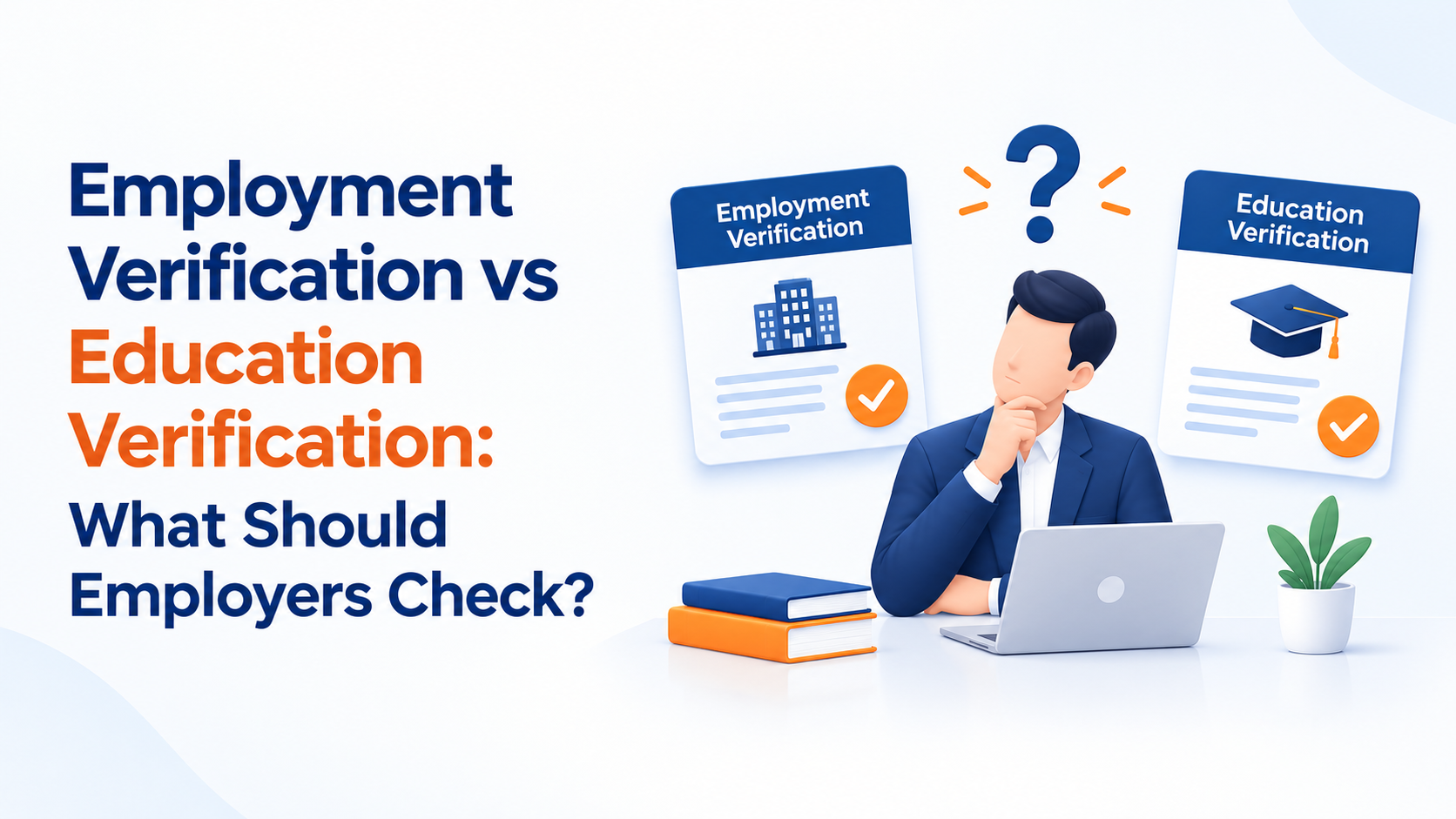
A candidate’s resume may look impressive, but how can an employer confirm that the information provided is accurate? Previous job experience and educational qualifications are two important parts of a candidate’s professional profile. While both help recruiters assess suitability, they establish different facts and require different verification methods.
Understanding employment verification vs education verification helps HR teams determine which checks are necessary before onboarding. Employment verification confirms details about a candidate’s professional history, while education verification establishes the authenticity of academic qualifications. Knowing the difference allows organisations to build a more consistent recruitment process and make decisions based on verified information rather than assumptions.
What Is Employment Verification?
Employment verification is a background screening process used to confirm the professional experience a candidate has listed in their resume or employment application. It helps employers establish whether the candidate worked for the stated organisation and whether the information provided matches the available employment records.
Depending on the role and the information available, the process may confirm previous employer names, job titles, employment dates and other relevant details, such as responsibilities or compensation history. Verification may involve contacting previous employers or using appropriate employment records and authorised verification channels.
For example, a candidate applying for a managerial position might claim six years of experience leading a team. Employment verification can help confirm the duration of the candidate’s previous employment and whether the reported position matches the employer’s records.
This check is particularly relevant for senior positions, specialised technical roles, financial services and jobs where previous experience directly influences the responsibilities assigned to a new employee.
What Is Education Verification?
Education verification focuses on confirming whether the academic qualifications listed by a candidate are genuine. It involves checking degrees, diplomas, certificates or other relevant credentials with the issuing university, college, institution or authorised verification channel.
The purpose is to establish whether the candidate holds the qualification claimed in the application. Depending on the institution and the verification process, the check may confirm the course completed, qualification awarded and other relevant academic details.
Consider a candidate applying for an engineering position who lists a specific degree as a mandatory qualification. Education verification helps the employer confirm the authenticity of that credential before finalising the hiring decision.
This check is important when a role requires a particular academic background, professional certification or specialised training. It can also help identify discrepancies between the qualifications stated on a resume and the records available from the issuing institution.
Employment Verification vs Education Verification: Key Differences
The main difference lies in what each check is designed to establish. Employment verification examines a candidate’s work history, whereas education verification examines academic credentials.
Employment verification generally relies on previous employers and relevant employment records. Education verification typically involves universities, colleges, examination boards or other issuing institutions. The information being checked, the sources contacted and the time required may therefore differ.
Neither check replaces the other. A candidate may possess a genuine degree but have overstated their professional experience. Similarly, a candidate may have substantial relevant work experience but provide an academic qualification that requires further confirmation.
For HR teams, the most useful approach is to treat both as separate components of a broader employee background verification process. Their relevance should depend on the job description, organisational policies and the requirements of the position.
Should Employers Conduct Both Verification Checks?
In many recruitment situations, conducting both checks provides a more complete understanding of a candidate’s stated credentials. However, the exact scope should be determined by the position rather than applying an identical process to every applicant.
For example, an experienced software developer may require detailed employment verification to confirm relevant work experience, along with education verification if the employer requires a particular qualification. A graduate applying for a first job may have limited employment history, making academic verification especially relevant.
For senior management or specialised professional positions, combining employment and education checks can help HR teams validate important claims before onboarding. Where a candidate has studied or worked overseas, international verification may also be necessary, depending on the employer’s requirements.
The objective is not simply to conduct more checks. It is to verify the information that matters for the role and review any discrepancies fairly.
How Can HR Teams Manage Verification More Effectively?
A consistent screening procedure begins with clearly defining the information that must be verified. HR teams should explain the process to candidates, obtain the necessary consent or authorisation, and ensure that the checks comply with applicable legal and data protection requirements.
When a discrepancy appears, employers should distinguish between confirmed inconsistencies and information that remains pending. A delayed response from a university or former employer does not automatically indicate that the candidate has provided false information. Giving candidates an appropriate opportunity to clarify differences supports fairer hiring decisions.
Maintaining clear records of verification status, follow-ups and final findings also helps HR teams manage recruitment more efficiently, particularly when multiple candidates are being screened simultaneously.
Choose GenesisRMS for Reliable Background Verification
Managing employment and education checks internally can require considerable coordination, particularly when previous employers or educational institutions take time to respond. A professional background verification partner can help organisations coordinate these checks and review relevant information through a structured process.
GenesisRMS offers employment verification and educational verification services to help organisations validate candidates’ professional histories and academic credentials. Its services include employment history checks, degree and certificate verification, and additional background screening options according to business requirements.
For businesses hiring in Mumbai and across India, GenesisRMS provides verification solutions that can support more consistent pre-employment screening. HR teams can select relevant services based on the role, the information requiring validation and their organisational policies.
Ready to Strengthen Your Hiring Process?
Employment verification and education verification answer different questions, but both can contribute to informed recruitment decisions. By understanding what each check confirms and selecting the right screening process for every role, employers can validate candidate information more effectively before onboarding.
If your organisation needs professional verification support, explore GenesisRMS Employment Verification Services and Educational Verification Services. Contact GenesisRMS to discuss a screening approach suited to your hiring requirements and build a more consistent, reliable recruitment process.